Brthrchristopher and Miss Aida,
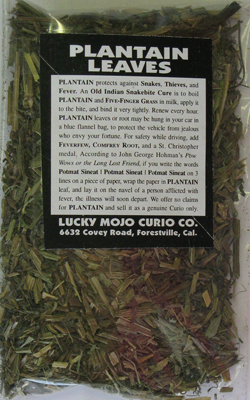
This is a variant of an old German folk-magic spell. The names can be written on a Plantain leaf -- not the Banana species that is called a Plantain, but Goose-Foot or Broad-Leaf Plantain, Plantago, the lawn weed that is called a Plantain, the one with the parallel ribs or veins in the leaf that look like lined paper. Here is a rosette of Plantain:

In the absence of a Plantain leaf, one may use a dried Bay leaf, as it forms a sturdy writing surface.
By the way, calling the information given by 1,605 African American rootworkers, "Hyatt spells" is highly misleading to the public and seems disrespectful to those whose practices Harry Hyatt collected. Hyatt was an amateur folklorist who did not believe in the efficacy of spell-craft at all, although he was continuously amazed by the divinatory powers of some of his informants (and he stated so repeatedly). Because of his dismissive attitudes toward the spells, despite his intense devotion to the process of collecting them, i prefer never to call them "Hyatt spells," but rather "the spells collected by Harry Hyatt from 1,605 mostly anonymous African American hoodoo practitioners between 1936 and 1940." Wordy, yes -- but accurate.
As to why an African American practitioner would tell Harry Hyatt a Germanic spell, that is fairly easy to explain: There is wide diversity among the informants, regionally, by age, by experience, and by ethnic background. With respect to the latter, although all of the people Harry Hyatt interviewed, except one, would have been conventionally listed as "Negro" people for the purposes of the United Stats census in 1930 - 1940, some were obviously part Native American, Sicilian, French, English, and so forth -- and openly stated as much. Due to their mingled ethnic backgrounds, and also due to natural human curiosity, which leads us to learn from our neighbors and friends of other backgrounds, many of the informants related to Hyatt the folklore of non-African cultures.
For the original German version of the spell, utilizing a Plantain leaf, see "Pow Wows or the Long Lost Friend" by John George Hohman. The English translation of 1848 cites Plantain; the more commonly encountered translation of 1858 erroneously translates the German word as "Knotweed," a plant with leaves too small to be written upon. The translation of 1858 is filled with errors of this sort, and only the translation of 1848 has correct botanical and medical terminology in it. Both editions have had wide circulation in candle shops and hoodoo drug stores from the 1880s through the present, and would have been readily available to Harry Hyatt's informants.
For more information on Harry Hyatt's informants, please see this "Hoodoo in Theory and Practice" web page:
Harry Middleton Hyatt's Informants
http://luckymojo.com/hyattinformants.html
For more information on Pow -Wows or The Long Lost Friend, please see this "Hoodoo in Theory and Practice" web page:
Pow-Wows: An Emblematic Example of the European Influence on Hoodoo
http://luckymojo.com/powwows.html
Here is the current edition of The Long Lost Friend that we are carrying in the Lucky Mojo shop:
BOO-GRI-TLLF
The Long-Lost Friend, A 19th Century American Grimoire, by John George Hohman
$19.99


You can order right here in the Forum by clicking on the blue Add To Cart button.
Good luck!